Truck Trailer Synchronization & Monitoring | Eagle-IoT
Truck Trailer Synchronization and Monitoring Solution
A truck and its trailer are often treated as one vehicle during transportation operations. In reality, they are two separate assets that can move independently. A tractor may be connected to different trailers throughout the day, while a trailer can remain parked, be exchanged between trucks, or move between locations without the fleet operator having complete visibility.
This creates an important operational challenge for logistics and transportation companies. Knowing where the truck is does not always mean knowing where the trailer is. When the connection between both assets is not properly monitored, fleet managers can lose visibility into trailer utilization, asset allocation, unauthorized movement and journey progress.
Eagle-IoT provides a connected approach to truck and trailer monitoring, allowing fleet operators to associate vehicles and trailers, monitor their movements and maintain better visibility across transportation operations.
What is Truck Trailer Synchronization?
Truck trailer synchronization is the process of connecting the operational identity of a truck with its assigned trailer within a fleet management system.
Instead of monitoring the tractor and trailer as completely independent assets, Eagle-IoT can provide a consolidated view of their operational relationship.
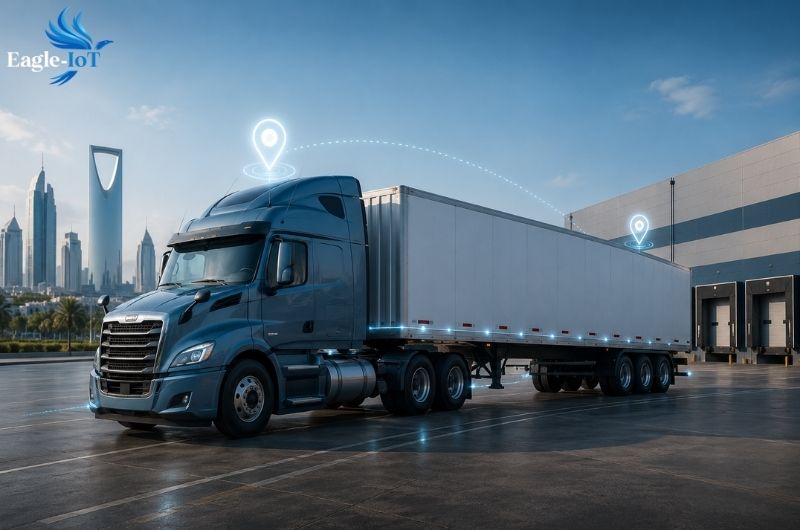
This can help fleet managers understand:
- Which trailer is connected to which truck
- Where the truck and trailer are located
- Whether the trailer is moving or stationary
- When assets are connected or separated
- Which journey or operation is being performed
- Whether a trailer has moved without the expected truck
- How trailers are being utilized across the fleet
Eagle-IoT’s Fleet Management Solution provides centralized visibility across vehicles and equipment, making truck-trailer synchronization part of a wider fleet management strategy.
Why Truck and Trailer Visibility Matters
A fleet manager may have accurate GPS information for every truck but still have limited visibility over trailers.
Consider a common transportation operation. A truck arrives at a warehouse, drops one trailer and connects another trailer before continuing its journey. If the trailer assignment is not updated, the fleet management system may continue to associate the truck with the previous trailer.
This can create discrepancies between the physical fleet and the digital fleet.
Eagle-IoT helps establish a clearer relationship between the assets so that fleet managers can understand the current operational status rather than relying on manual records or assumptions.
The objective is not simply to know where an asset is. The objective is to understand which asset is connected, where it is operating and how it is being utilized.
Real-Time Truck and Trailer Monitoring
Eagle-IoT provides real-time tracking capabilities that allow fleet operators to monitor asset locations through a centralized platform.
For trucks, this provides visibility into current location, movement, and journey activity. For trailers, independent monitoring can maintain visibility even when a trailer is separated from its tractor, depending on the tracking configuration deployed on the asset.
The Eagle-IoT Vehicle Tracking Solution provides live GPS visibility, geofencing, journey information, alerts and fleet reporting through a centralized platform.
This distinction is important.
A trailer that has been disconnected from its truck should not become an invisible asset. Fleet operators can continue monitoring the trailer and identify its current location and movement.
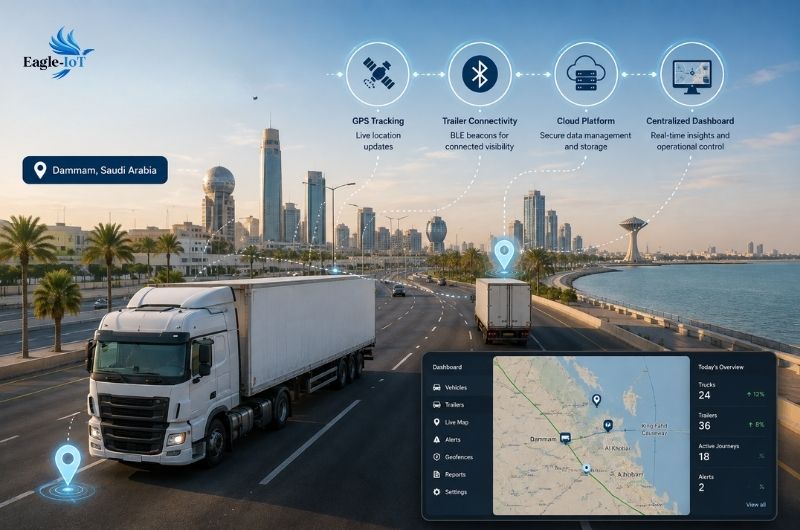
The dedicated Truck & Trailer Monitoring Solution uses Bluetooth Low Energy (BLE) beacon technology alongside GPS tracking to provide visibility into trailer location, movement, detachment and security events.
Automated Trailer Association
Manual trailer allocation can become difficult when fleet operations involve hundreds or thousands of assets.
Drivers may change trailers during their shifts. Dispatch teams may allocate trailers according to customer requirements. Maintenance teams may remove trailers from service, while operations teams may transfer them between locations.
Eagle-IoT can support the digital association of truck and trailer assets, helping fleet managers maintain an updated operational relationship between them.
This provides a more structured view of fleet allocation and reduces dependence on spreadsheets, telephone calls and manual updates.
The fleet operator can identify the truck, the assigned trailer and the associated journey from a centralized environment.
Monitor Trailer Movement After Disconnection
One of the important capabilities of trailer monitoring is maintaining visibility after the trailer is separated from the truck.
For example, a truck may deliver a loaded trailer to a distribution center and leave with another trailer. The original trailer may remain at the facility for several hours or days.
Without independent trailer monitoring, the fleet operator may have limited information about its exact location and status.
With Eagle-IoT, independently monitored trailers can remain visible within the platform. BLE beacons attached to trailers communicate with Eagle-IoT GPS tracking units, which relay beacon information together with GPS data to the cloud platform.
This helps fleet managers identify:
- Trailer location
- Trailer movement
- Stationary periods
- Unauthorized movement
- Asset utilization
- Time spent at specific locations
The result is better control over an asset that would otherwise be difficult to track.
Improve Trailer Utilization
Trailer availability directly affects transportation productivity.
A trailer that remains unused for several days represents an underutilized fleet asset. However, identifying this problem is difficult when trailer activity is recorded manually.
Eagle-IoT provides historical tracking and journey information that can help fleet managers analyze trailer movement and utilization patterns.
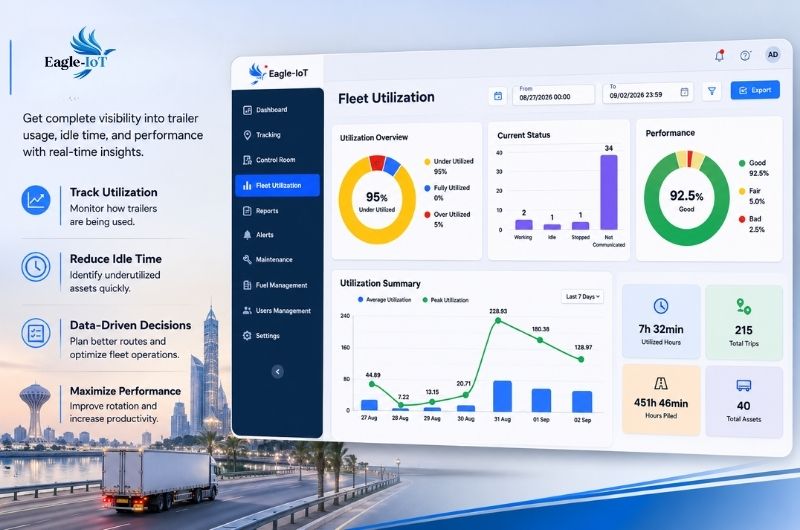
Fleet operators can review where trailers have travelled, how long they remained stationary and how frequently they were used.
This information can support better fleet planning and help companies determine whether additional trailers are genuinely required or whether existing assets are being underutilized.
The Eagle-IoT Trailer Monitoring Solution is specifically designed to help reduce trailer idle time, improve trailer rotation and provide visibility into underutilized assets.
Geofencing for Trailer Operations
Geofencing adds another operational layer to truck and trailer monitoring.
Fleet managers can define geographical boundaries around warehouses, depots, customer locations, restricted areas and other operational zones.
When a monitored asset enters or exits a defined area, the system can record the event and generate relevant alerts based on the configured rules.
For trailers, this can help monitor movements around controlled locations.
For example, a trailer that leaves a designated yard outside its expected operating schedule can be identified for further investigation.
Eagle-IoT supports geofence-based alerts for defined operational areas, helping fleet teams identify unauthorized movement and respond to unexpected asset activity.
Geofencing therefore changes trailer monitoring from passive location tracking into an operational control mechanism.
Journey Management for Truck and Trailer Operations
Truck and trailer monitoring becomes more valuable when it is connected with journey management.
Eagle-IoT provides journey visibility that enables fleet operators to understand the movement of assets throughout their assigned operations.
The fleet manager can use journey information to evaluate whether the truck is following the expected route, identify deviations and review completed trips.
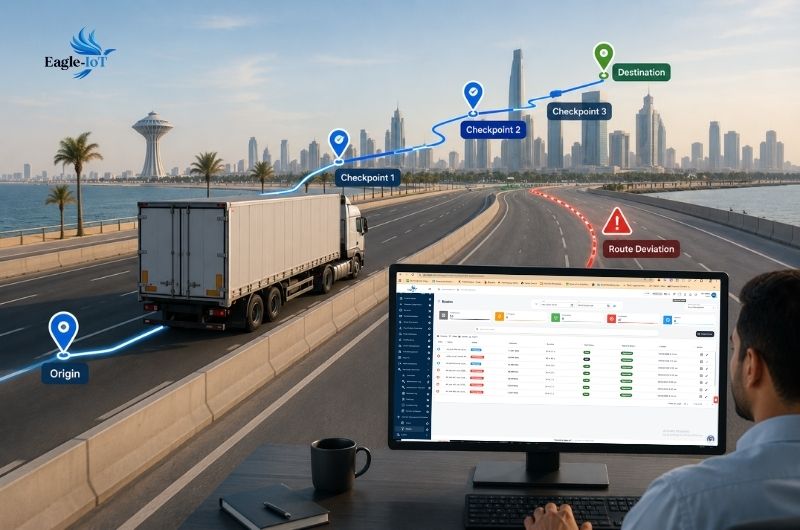
This is particularly important for transportation and logistics companies operating multiple vehicles and trailers across different locations. Eagle-IoT’s Transportation and Logistics Fleet Management Solution combines tracking, utilization, asset management, driver monitoring and other operational capabilities within the same fleet environment.
When truck and trailer information is synchronized with journey operations, fleet managers gain a more complete picture of transportation activity.
Instead of asking only:
Where is my truck?
The operation can answer:
Which trailer is assigned, where is the combined operation currently located, which journey is being performed and what happened during the journey?
That is a significantly more useful operational view.
Alerts for Better Fleet Control
Monitoring becomes effective when fleet managers are notified about events that require attention.
Eagle-IoT supports configurable fleet alerts that can help identify conditions such as unauthorized movement, excessive idling, overspeeding and other operational events.
For trailer operations, alerts can also be configured around geofence activity, unauthorized movement, trailer detachment and inactivity.
When applied to truck and trailer operations, these alerts can help fleet teams respond faster to unexpected asset activity.
For example, if a trailer begins moving outside its expected operational window or geographical area, the event can be reviewed by the responsible team.
This reduces the need for fleet personnel to continuously monitor every asset manually.
Connecting Trailer Monitoring with Fleet Performance
Truck and trailer visibility should not operate as an isolated function.
Transportation companies also need to understand fuel consumption, driver performance, maintenance requirements and overall fleet utilization.
For example, a truck that repeatedly operates inefficiently may require a closer review of driver behavior, fuel consumption or maintenance condition.
Eagle-IoT’s broader fleet management capabilities provide visibility into driver behavior, fuel reporting, maintenance, utilization and other operational data.
This makes trailer monitoring more valuable because trailer activity can be evaluated alongside the wider operational performance of the fleet.
A Centralized View of the Connected Fleet
Large transportation operations generate substantial amounts of fleet data.
Truck locations, trailer movements, journeys, driver activity, alerts and historical trips can become difficult to manage when information is distributed across different systems.
Eagle-IoT brings these operational elements into a centralized fleet management environment.
Fleet managers can monitor their assets, review historical activity and analyze fleet operations from a single platform.
The Eagle-IoT Fleet Management Solution provides a centralized dashboard for monitoring vehicles and equipment, supporting a broader approach to connected fleet and asset management.
Truck Trailer Synchronization for Modern Fleet Operations
Truck and trailer synchronization should not be viewed as another layer of GPS tracking. It is an important part of maintaining asset accountability across transportation operations.
A truck can change trailers. A trailer can change trucks. A trailer can remain stationary while the truck continues its journey. It can also move independently between operational locations.
These scenarios make it necessary to monitor the relationship between both assets rather than treating them as a single permanent unit.
Eagle-IoT enables fleet operators to bring truck and trailer visibility together through real-time tracking, asset association, journey management, geofencing, alerts and historical fleet data.
For logistics and transportation companies, this creates better control over mobile assets, improves operational visibility and supports more effective fleet utilization.
The ultimate objective is simple: know where every truck and trailer is, understand how they are being used and maintain visibility throughout the transportation operation.
(FAQ ) Frequently Asked Questions About TGA Motorcycle Tracking
What is truck trailer synchronization?
Truck trailer synchronization is the process of digitally associating a truck with its assigned trailer within a fleet management system. It helps fleet operators maintain visibility of the truck, trailer, journey and asset activity, even when trailers are exchanged, detached or reassigned.
Can a trailer be tracked when it is disconnected from a truck?
Yes. A trailer can be monitored independently when it is equipped with the appropriate tracking configuration. This allows fleet operators to maintain visibility of the trailer’s location and movement after it has been detached from the truck.
How does truck and trailer tracking work?
Truck and trailer tracking combines vehicle GPS tracking with trailer identification and monitoring technology. Depending on the deployment, a trailer can use a BLE beacon that communicates with a compatible GPS tracking device installed on the truck. The collected information can then be transmitted to a centralized fleet management platform.
What happens when a trailer is detached from a truck?
When a trailer is detached, its monitoring status can continue independently when an appropriate trailer tracking configuration is deployed. The fleet operator can continue to monitor the trailer and identify its location, movement and activity rather than losing visibility when the truck and trailer separate.
Can unauthorized trailer movement be detected?
Yes. Trailer monitoring systems can detect unexpected movement and generate alerts based on configured operational rules. Geofences can also be used around depots, warehouses, customer locations and restricted areas to identify trailer movement outside expected geographical boundaries.
Can trailer monitoring use geofencing?
Yes. Geofencing can be used to monitor trailer activity around predefined locations. When a monitored trailer enters or exits a designated geographical area, the system can record the event and generate an alert when required.
How can trailer monitoring improve fleet utilization?
Trailer monitoring provides visibility into trailer movement, location and stationary periods. Fleet managers can identify underutilized trailers, understand asset usage patterns and improve trailer allocation and rotation across different operations.
Can a fleet management system show which trailer is assigned to a truck?
Yes. When truck and trailer assets are properly configured and associated within the fleet management system, operators can identify the relationship between the truck and its assigned trailer. This improves asset allocation visibility and helps maintain more accurate operational records.
Can trailer location be monitored in real time?
Yes. When the trailer has the required tracking configuration, its location can be monitored through a connected fleet management platform. Real-time visibility allows fleet operators to understand where trailers are currently located and whether they are moving or stationary.
Can trailer movement history be reviewed?
Yes. Historical tracking data can be used to review previous trailer movements, locations and stationary periods. This information can support asset utilization analysis, movement investigations and operational planning.
Can truck and trailer monitoring be connected with journey management?
Yes. Truck and trailer monitoring can be integrated with journey management to provide a broader view of transportation operations. Fleet managers can relate vehicle and trailer activity to assigned journeys, routes and operational events.
How does Eagle-IoT synchronize trucks and trailers?
Eagle-IoT uses connected asset identification and tracking technology to associate trailers with their operating trucks and provide centralized visibility. Depending on the deployment, BLE beacons can be installed on trailers and communicate with Eagle-IoT GPS tracking devices, allowing trailer information to be transmitted to the platform.
Can Eagle-IoT monitor a trailer after it is detached?
Yes. With the appropriate trailer monitoring configuration, Eagle-IoT can maintain visibility of a trailer after it is separated from its truck. This allows fleet operators to monitor trailer movement and location without relying solely on the truck’s GPS device.
Does Eagle-IoT provide truck and trailer monitoring from one platform?
Yes. Eagle-IoT provides a centralized fleet management environment where operators can monitor trucks, trailers and other connected assets. This creates a unified operational view and reduces the need to manage truck and trailer information through separate systems.
What types of trailers can be monitored?
Different types of mobile trailers can be monitored depending on the tracking hardware, communication architecture and operational requirements. Trailer monitoring can be applied to logistics, transportation, distribution and other operations where independent trailer visibility is required.
Can trailer monitoring be used for logistics and transportation fleets?
Yes. Trailer monitoring is particularly useful for logistics and transportation operations where trailers are frequently exchanged, detached, parked at different facilities or assigned to different trucks. It provides greater asset accountability and improves visibility across the transportation network.
Can trailer monitoring help reduce idle trailer time?
Yes. Monitoring trailer location and stationary periods can help fleet managers identify assets that remain unused for extended periods. This information can support better trailer allocation, rotation and utilization.
Can truck and trailer monitoring help prevent asset loss?
Yes. Continuous visibility, movement monitoring, geofencing and alerts can help fleet operators identify unexpected trailer movement and locate assets more efficiently. Historical activity can also support investigations when an asset moves outside its expected operational pattern.
What is the difference between truck tracking and trailer monitoring?
Truck tracking primarily provides visibility into the vehicle, while trailer monitoring treats the trailer as a separate asset that can be monitored independently. This distinction becomes important when trailers are detached, exchanged, parked or moved without their original truck.
Why is truck trailer synchronization important for fleet management?
Truck trailer synchronization gives fleet operators a more accurate view of how vehicles and trailers are being used together. It helps improve asset accountability, trailer utilization, journey visibility and operational control, particularly in fleets where trailers are frequently exchanged or detached.