


What is fleet expense management?
Fleet expense management is the process of monitoring, recording, approving and controlling the operational expenses associated with company vehicles, drivers and fleet assets. It helps organizations understand where their money is being spent, identify unusual transactions and maintain accountability across fleet operations.
Three controls are particularly important:
- Spending policies: Define approved spending limits and procedures for fuel, maintenance, tolls and other operational expenses.
- Transaction verification: Compare reported expenses with vehicle activity, mileage, fuel consumption and supporting records to identify discrepancies.
- Budget monitoring: Track expenses by vehicle, driver, department or branch against allocated budgets and investigate unusual spending.
For businesses operating in Saudi Arabia, combining clearly defined expense policies with digital fleet management and reporting provides better financial visibility and control.
Managing a fleet involves much more than monitoring vehicle locations and ensuring that drivers reach their destinations on time. Every vehicle generates operational expenses, from fuel consumption and routine maintenance to unexpected repairs, parking and road tolls. When these expenses are spread across multiple vehicles, branches and drivers, maintaining financial control becomes a considerable responsibility.
For fleet managers in Saudi Arabia, the challenge is not simply knowing how much the organization spends, but understanding where the money goes, whether the expenditure is justified and how effectively the available fleet budget is being utilized. A vehicle that frequently visits workshops, consumes more fuel than expected or remains underutilized can gradually become a financial burden without structured oversight. Without a systematic expense management process, these hidden costs may remain unnoticed until they begin heavily impacting the operating budget.
Fleet expense management provides a structured approach to monitoring these costs by combining spending policies, transaction records, vehicle utilization data and financial reporting. Eagle-IoT provides robust fleet expense management capabilities that help businesses record operational costs, monitor asset utilization, compare expenditure and generate reports for more informed fleet management decisions.
What are fleet expense policies?
Fleet expense policies are documented rules that define how employees, drivers and fleet departments are permitted to spend company money while operating and maintaining vehicles. These policies establish spending limits, approval procedures, documentation requirements and responsibilities for different expense categories. They also help prevent unauthorized purchases, unnecessary repairs and inconsistent expense reporting across departments.
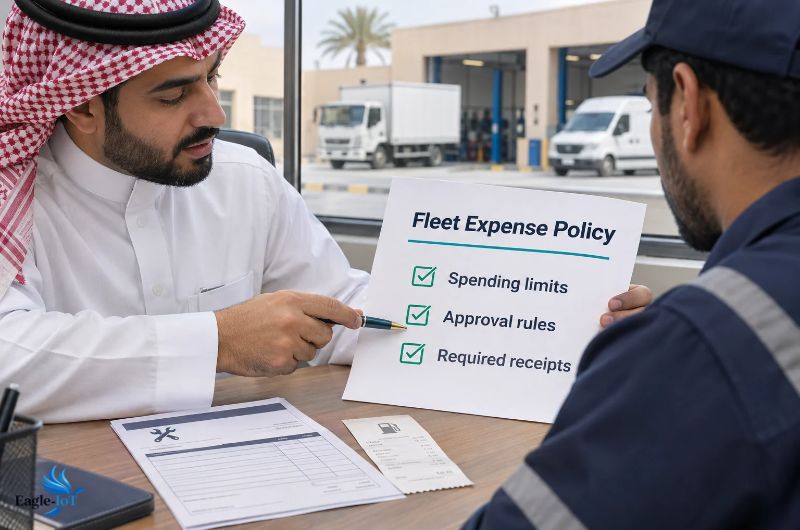
For organizations managing fleets across Saudi Arabia, a structured expense policy should address at least the following core operational areas:
1. Fuel expense policy
Fuel is one of the most significant recurring expenses in fleet operations. Without proper monitoring, differences in fuel consumption, unauthorized purchases and inefficient driving practices can gradually increase operating costs. A robust fuel expense policy should define approved fuel stations, allocation limits based on vehicle category, and mandatory recording of fuel quantities and odometer readings. Fleet managers should also compare fuel consumption between similar vehicle models to identify assets that consistently burn more fuel than expected.
2. Maintenance and repair expense policy
Maintenance expenses can become difficult to control when repairs are approved without proper documentation or when vehicles repeatedly visit workshops for identical problems. An effective maintenance policy should outline approved service providers, preventive maintenance schedules, and clear approval requirements for major repairs and replacement parts. Monthly maintenance expenditure reviews by vehicle and branch help fleet managers quickly spot assets that are becoming excessively expensive to operate.
3. Toll, parking and route-related expenses
Toll charges and parking expenses are frequently overlooked when organizations calculate their total fleet expenditure. A comprehensive policy should clarify which journeys qualify for reimbursement and how employees must document these expenses using electronic toll records or valid receipts. For Saudi fleet operators, these controls must align directly with actual operating routes, applicable toll arrangements and internal travel procedures.
Why is expenditure oversight important for controlling fleet costs?
Fleet expenditure oversight is essential because the total cost of operating a vehicle is not always reflected solely in its initial purchase price, monthly fuel bill or periodic maintenance invoice. A fleet can appear financially healthy on paper while individual vehicles generate unnecessary expenses through excessive fuel consumption, repeated repairs or unmonitored operational spending.
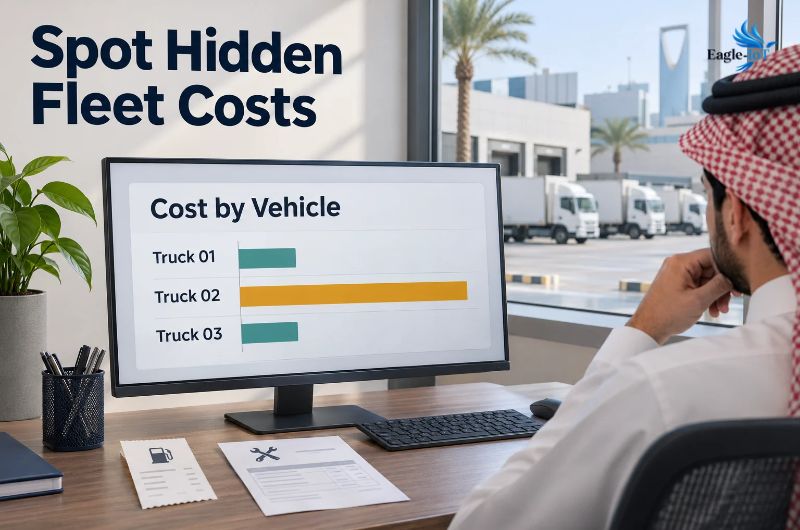
Consider an organization operating 150 vehicles across three separate branches where each branch follows a different manual expense recording process; management will inevitably struggle to establish a reliable picture of its total fleet expenditure.
This fragmented approach creates several critical challenges for growing businesses:
- Limited cost visibility: Management cannot easily identify which specific vehicles or branches are generating the highest operational expenses.
- Delayed expense identification: Unusual spending patterns often remain hidden until quarterly or annual financial reviews take place.
- Weak accountability: Without vehicle-level expense records, determining the exact operational reason behind a particular expenditure is nearly impossible.
- Inefficient asset allocation: Vehicles carrying high maintenance costs or low utilization continue operating without proper financial evaluation.
Eagle-IoT helps address these challenges through centralized expense recording, service and renewal management, asset utilization monitoring and advanced analytics dashboards. Fleet managers can easily compare expenditures between vehicles and branches, examine historical maintenance records and evaluate asset performance against operating costs. The ultimate objective is not simply to reduce spending, but to ensure every riyal contributed directly supports the operational requirements of the fleet.
How do fleets improve spend management?
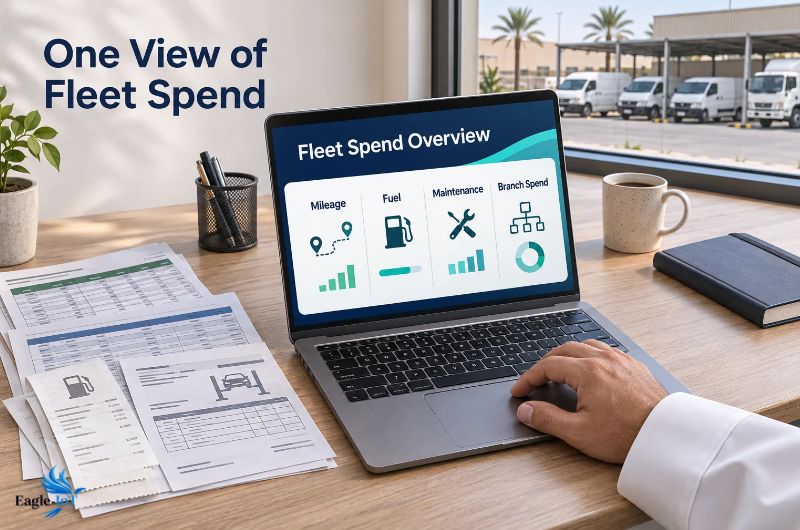
Improving fleet spend management requires organizations to move away from disconnected manual spreadsheets and transition toward a structured digital workflow that connects operational telematics with financial reporting. While manual spreadsheets can work for smaller operations, they become increasingly unmanageable as fleet size and operational complexity scale up.
Traditional vs. Digitally Managed Fleet Expenses
| Traditional Expense Management | Digitally Managed Fleet Expenses (Eagle-IoT) |
| Manual expense spreadsheets and scattered files | Centralized, secure digital expense records |
| Individual paper fuel receipts | Automated fuel transaction and mileage comparison |
| Maintenance invoices stored in separate folders | Vehicle-specific maintenance and service history |
| Branch expenses reviewed independently | Branch-wise comparative expenditure analytics |
| Periodic, end-of-year budget reviews | Accessible, real-time expenditure dashboards |
| Difficult identification of unusual spending | Instant identification of spending anomalies |
| Limited vehicle-level cost visibility | Granular vehicle and asset-level cost analysis |
One of the most powerful aspects of digital fleet management is understanding the distinct financial performance of individual vehicles. For example, two vehicles belonging to the same category may log similar mileage yet exhibit drastically different maintenance expenses. By recording workshop assignments, repair costs, fuel usage and distance traveled in one place, fleet managers can investigate the underlying operational reasons. Eagle-IoT provides vehicle usage and expense reporting capabilities that help organizations examine asset performance and pinpoint underutilized or overutilized vehicles.
How do fleets spot unusual purchases faster?
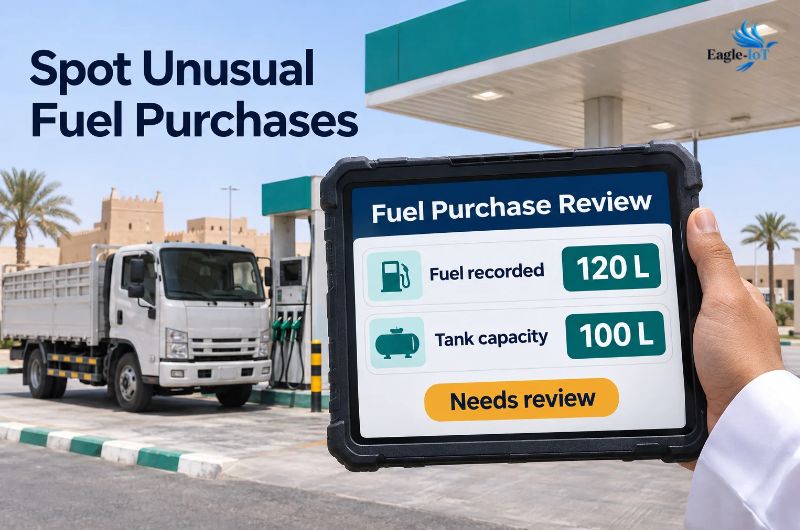
Unusual purchases are not always the result of intentional misuse; they can also stem from clerical entry errors, poor recordkeeping, emergency roadside repairs or sudden operational shifts. The core challenge for fleet managers is identifying these exceptions before they compound into recurring budget overruns. Fuel transactions demand special attention because they occur frequently, involve multiple drivers, and span various service stations across the Kingdom.
Fuel Transaction Exceptions to Monitor
| Transaction Exception | What Fleet Managers Should Investigate |
| Multiple fuel purchases within a short timeframe | Verify whether the transactions are legitimate business stops |
| Fuel quantity exceeds vehicle tank capacity | Check for data entry errors, duplicate charges or unauthorized use |
| High fuel expenditure combined with low mileage | Investigate potential engine inefficiency, idling, or transaction discrepancies |
| Missing or incomplete odometer readings | Enforce complete transaction documentation and driver compliance |
| Significant spikes in fuel consumption | Assess vehicle mechanical condition, driver behavior or operational changes |
| Fuel purchases outside approved procedures | Confirm proper management authorization and business justification |
Vehicle tracking and fuel consumption telemetry provide crucial operational context when investigating these transactions. For instance, if a vehicle logs unusually high fuel expenditure while covering significantly fewer kilometers than expected, the fleet manager has an immediate trigger to investigate both the transaction and driver behavior.
Use Alerts to Identify Exceptions
Automated alerts help fleet managers identify critical operational events without manually reviewing every individual vehicle record. Depending on system configuration, organizations can establish active monitoring around excessive vehicle idling, unusual fuel consumption patterns, overspeeding, unauthorized usage, and upcoming maintenance renewals.
How do you set fleet spending alerts?
Spending alerts should be anchored to predefined budgets, operational requirements and the organization’s internal expense approval policy. Setting generic alerts without defining what constitutes unusual expenditure generates notification fatigue and makes it difficult for managers to catch genuine exceptions.
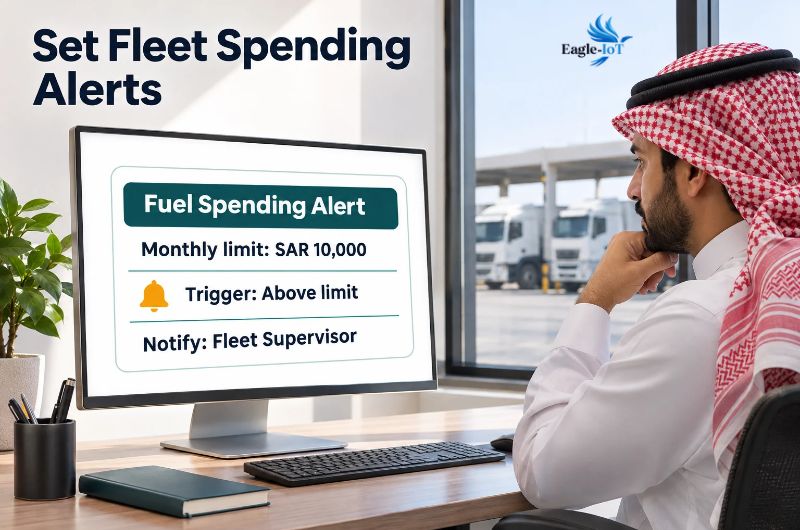
A structured approach involves five key steps:
- Establish a baseline budget: Determine expected monthly expenditure for each vehicle category, branch or department using historical fuel consumption, distance traveled, and maintenance history.
- Define spending thresholds: Set internal thresholds for different expense categories so that spending exceeding approved monthly limits triggers an immediate management review.
- Assign approval responsibilities: Define precisely who receives an alert and who holds authorization to approve exceptional expenses (e.g., fuel exceptions require supervisor sign-off, while major overhauls require executive approval).
- Monitor expenditure regularly: Compare actual spending against allocated budgets continuously, investigating unusual variations rather than waiting until year-end.
- Maintain an audit trail: Document the business justification for every exceptional purchase, the approving manager, and corrective actions taken to ensure total accountability.
With Eagle-IoT’s analytics dashboards and expense recording tools, organizations can review expenditure by asset and branch, examine historical logs, and leverage accurate operational data to support smarter spending decisions.
How does Eagle-IoT support fleet expense management in Saudi Arabia?
Managing expenses across a growing commercial fleet requires far more than basic accounting spreadsheets. Fleet managers need actionable operational insight that explains precisely how vehicles are utilized and where hidden costs originate. Eagle-IoT brings fleet monitoring, asset management, service records, expense tracking and reporting into a single, centralized environment.
Its comprehensive platform capabilities support several critical areas of expenditure oversight:
- Expense recording and analysis: Easily record operational expenses and examine exact costs associated with individual vehicles and assets.
- Maintenance cost management: Assign approved workshops, log maintenance expenditures, and maintain complete vehicle-specific service histories.
- Asset utilization monitoring: Identify underutilized and overutilized vehicles by analyzing operational usage patterns and total distance traveled.
- Branch-wise expenditure comparison: Compare expenses and asset performance seamlessly across different regional operational locations in KSA.
- Budget planning: Utilize historical operational and expenditure data to forecast and build accurate annual fleet budgets.
- Vehicle performance reporting: Examine fuel usage, mileage, maintenance history and utilization to understand all variables driving fleet operating costs.
For businesses throughout Saudi Arabia, these robust capabilities provide a practical foundation for mastering expenditure across diverse vehicle categories and operational demands. Eagle-IoT is engineered to help organizations make confident decisions using reliable fleet data rather than relying entirely on manual expense reviews.
Frequently Asked Questions (FAQs)
What are the main expenses involved in fleet management?
The main fleet expenses include fuel, preventive maintenance, unexpected repairs, insurance, vehicle registration, operational permits, depreciation, parking, tolls and other vehicle-related costs. These operational expenses are typically classified into fixed and variable costs.
How can fleet managers reduce fuel expenses?
Fleet managers can reduce fuel expenses by monitoring fuel consumption, reviewing mileage, reducing unnecessary engine idling, improving driver behavior and identifying unusual consumption patterns. Comparing similar vehicles side-by-side also helps identify assets with higher-than-expected fuel requirements.
What is the difference between fleet expense management and fleet cost management?
Fleet expense management focuses specifically on recording, monitoring, approving and controlling individual monetary expenditures. Fleet cost management takes a broader, holistic approach by examining the total cost of operating and maintaining fleet assets, including fixed overhead, variable expenses, utilization rates and asset lifecycle considerations.
How does fleet management software help control expenses?
Fleet management software centralizes operational information and expense records, allowing managers to review fuel consumption, maintenance costs, vehicle utilization and detailed expenditure reports. It significantly improves cost visibility and supports more informed operational decisions.
Why should companies have a fleet expense policy?
A fleet expense policy establishes consistent spending procedures, approval limits and documentation requirements. It actively reduces unauthorized expenditure, improves financial accountability and ensures that all operational expenses are recorded and reviewed systematically.
Take Control of Your Fleet Expenditure with Eagle-IoT
Fleet expenses should never become an uncontrolled blind spot in your business operations. Organizations require clear spending policies, reliable expense records and deep operational visibility to understand where their capital is being utilized. Whether managing a small commercial fleet or hundreds of vehicles distributed across multiple Saudi branches, implementing the right expense management process makes a profound difference to financial performance.
Eagle-IoT helps businesses monitor fleet operations, record expenses, analyze asset utilization and compare expenditures through centralized dashboards and reporting. Request an Eagle-IoT demo today and discover how better fleet visibility can support more effective expense management and cost control across your operations.
